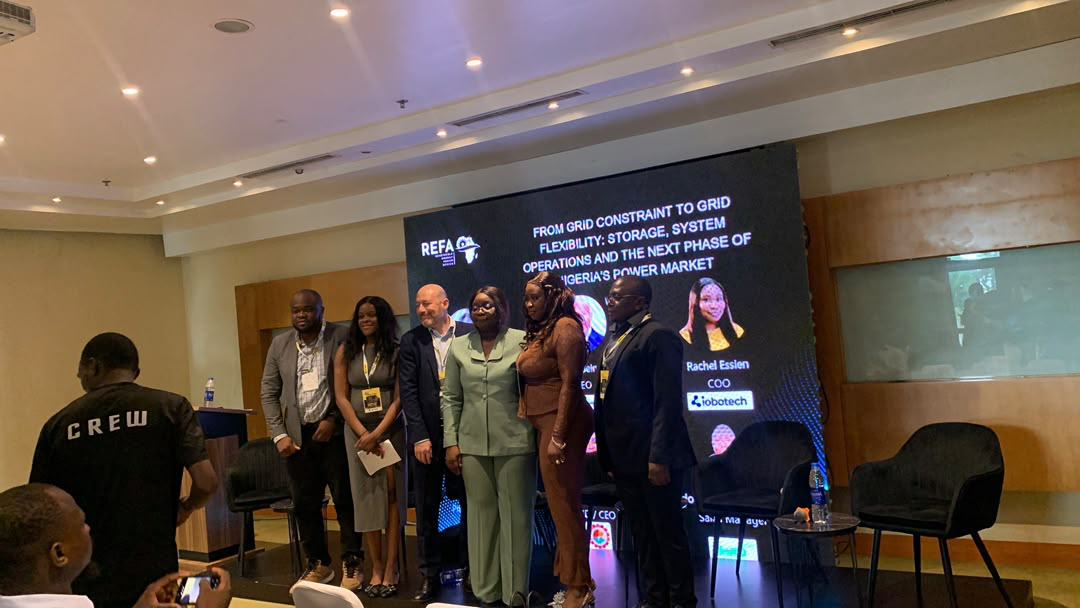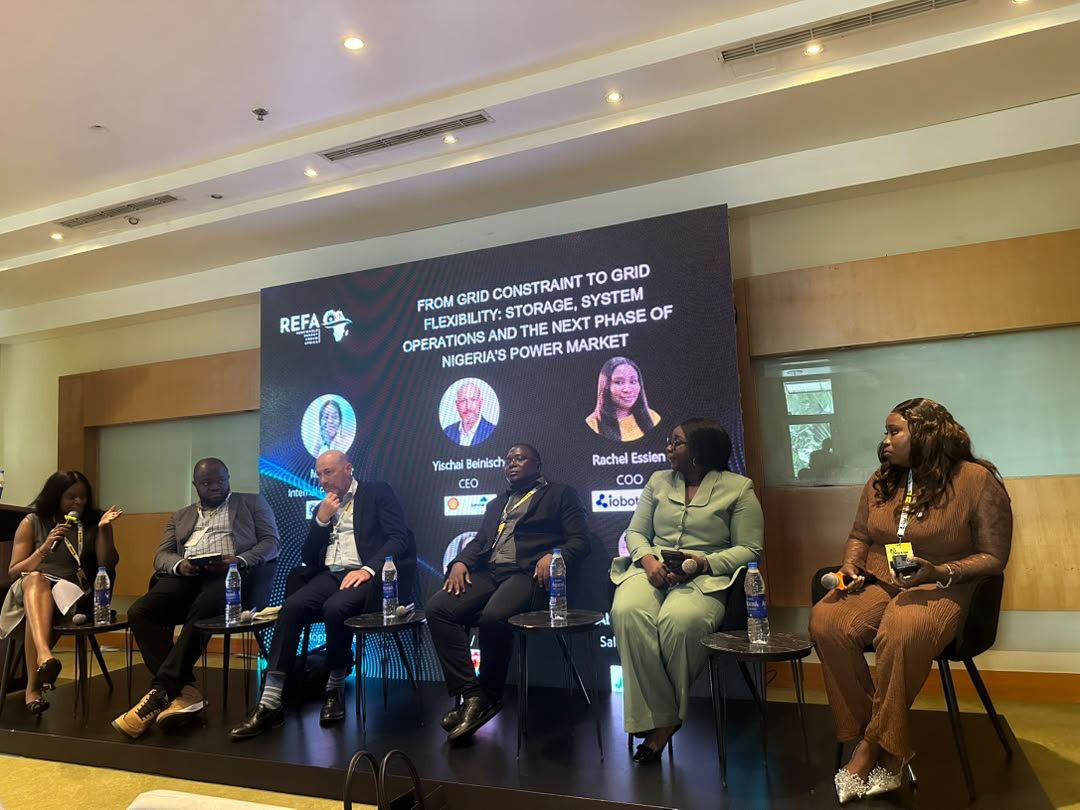
The panel: from grid constraint to grid flexibility
Rachel Essien, Chief Operating Officer of IOBOTECH Limited, spoke at REFA 2026 on “From Grid Constraint to Grid Flexibility: Storage, System Operations and the Next Phase of Nigeria’s Power Market”. The organiser’s announcement names her among the Day 1, Round 2 panellists at the Radisson Blu Anchorage Hotel in Lagos.
The panel focused on how battery storage, flexible generation and smarter system operations can help Nigeria move beyond grid constraints. Rachel brought the implementation perspective: how energy assets, metering, data, controls and revenue systems can work together to make electricity infrastructure commercially sustainable.
The following questions and highlights capture Rachel’s on-stage contribution. Her remarks connect the technical conversation about grid flexibility with the practical realities of operating and financing local energy networks.
1. What equipment, data, controls and metering make a system intelligent?
Rachel explained that an intelligent energy system is not simply a collection of solar panels, batteries and inverters. Every component must communicate, be measured, be controlled and operate within a sustainable commercial framework.
She identified five connected layers: generation from solar, grid electricity and generators; storage through batteries and smart inverters; intelligent metering; real-time data and control; and commercial infrastructure for billing, tariffs, revenue collection, reconciliation and settlement.
In an estate using grid electricity, solar, batteries and diesel, operators need to know which source is available, which is economical, how much each customer consumes and how to bill that consumption. Visibility must extend to timing, source, supply cost and the effect on the wider network.
“A meter should no longer be seen as just a billing device. It should be seen as a critical data point within an intelligent energy network.” — Rachel Essien
2. Who should control when a battery charges, discharges or exports?
Rachel advocated a coordinated, automated system that balances the customer’s need for affordable reliability, the provider’s need for efficient operations and the distribution company’s need for network stability.
An Energy Management System should act within predefined parameters: grid electricity cost, solar availability, battery state of charge, consumption patterns, local network capacity and the minimum reserve needed to protect the customer. Abundant afternoon solar can charge a battery; evening discharge can reduce peak reliance on the grid.
She stressed that ownership and commercial agreements matter. Customers should retain agreed rights over their assets, with automation operating within agreed boundaries. Export is appropriate only where permitted and commercially beneficial.
“The future of energy management is not about choosing who controls the battery. It is about creating an intelligent system that aligns the interests of everyone connected to it.” — Rachel Essien
3. Where do projects become difficult in practice?
For Rachel, the biggest implementation challenge is fragmentation. Solar equipment, batteries, inverters, meters, payment platforms and distribution infrastructure often come from different providers and operate independently rather than as one ecosystem.
She highlighted six practical challenges: safe interconnection; accurate import, export and source-based metering; incompatible data protocols; unreliable connectivity; utility coordination; and commercial agreements covering tariffs, revenue sharing, ownership and compensation.
A solar-and-battery installation may work technically while struggling commercially if its metering cannot distinguish grid electricity from alternative sources. Distribution companies also need visibility into how privately owned assets affect transformers and feeders.
Rachel described IOBOTECH’s role as an integrated digital layer connecting smart metering, monitoring, revenue collection and operational intelligence. She called for technology adapted to African realities, including temporary internet interruptions.
“Nigeria does not only have an energy infrastructure problem. We also have an energy visibility, coordination and revenue assurance problem.” — Rachel Essien
4. What can be implemented now—and what needs market changes?
Rachel argued that intelligent energy management can begin at customer, estate, commercial facility, university, mini-grid, transformer and feeder levels without waiting for nationwide grid modernisation.
She identified smart prepaid and bidirectional metering, multi-source accounting subject to tariff rules, transformer and feeder monitoring, outage monitoring, automated billing, battery optimisation, peak-demand management, remote monitoring, loss detection and source switching as practical project-level opportunities.
Customer exports, dynamic pricing, virtual power plants, compensated battery grid support, peer-to-peer trading and large-scale demand response require the relevant market rules, interconnection arrangements, customer agreements, measurement and settlement systems. Individual projects must meet applicable regulations and technical requirements.
Her recommendation was to begin with controlled pilots in estates, industrial clusters and commercial communities, working with distribution companies and state regulators. Measure reductions in network pressure, collection improvements and reliability before scaling.
“We do not have to wait for a smart national grid to start building smart local energy networks.” — Rachel Essien
5. Should batteries be compensated for supporting the network?
Rachel’s answer was yes: battery value should include the services it provides to the electricity network, not just the electricity it stores. Reducing peak demand can ease transformer pressure, defer upgrades and improve reliability.
She emphasised that this value must be measured and verified against an agreed baseline. Smart meters, transparent data and a commercial framework are needed to compensate customers for verified services; participation should not be assumed to be free.
“We should move from paying exclusively for electricity consumed to also recognising the value of electricity demand reduced at the right time.” — Rachel Essien
6. What role does IOBOTECH play in Nigeria’s electricity market?
Rachel positioned IOBOTECH as the digital and commercial infrastructure connecting energy producers, distribution networks and consumers. Through IEROS—its Energy Revenue Operating System—the focus is on making energy investments intelligent, measurable, manageable and commercially sustainable, rather than becoming another solar-farm or large-scale battery developer.
Her remarks connected smart metering, revenue collection, energy monitoring, transformer intelligence and payment infrastructure with greater operational visibility and improved revenue recovery.
According to the company figures Rachel shared, IOBOTECH reports more than 600 enterprise customers, more than 42,000 connected endpoints and over $23 million in lifetime energy collections. These are company-reported figures, not independently audited metrics; connected endpoints are distinct from deployed meters.
“We do not build energy infrastructure; we make energy infrastructure sustainable.” — Rachel Essien
7. Can distributed energy and storage solve Nigeria’s electricity challenges?
Rachel described distributed energy as a complement to the national grid, not a replacement. Nigeria needs a coordinated relationship between centralised generation and decentralised resources.
Solar-and-battery systems in estates, factories, commercial buildings and universities can become more than isolated backup installations. Where permitted, intelligent coordination with the distribution network can make them active participants in a more flexible electricity market.
She identified three inseparable requirements: infrastructure, digital intelligence and a sustainable commercial framework. Generating more electricity alone does not resolve the challenges of measuring, managing and recovering investment in it.
Rachel’s closing message: smarter infrastructure
Rachel closed around four principles: decentralisation, digitisation, flexibility and commercial sustainability. The next phase of Nigeria’s power market must consider not only megawatts generated, but how intelligently they are distributed, efficiently consumed and sustainably monetised.
“Every smart meter, every battery, every solar installation and every distribution transformer should progressively become part of a more intelligent and connected energy ecosystem.” — Rachel Essien
“At IOBOTECH, we believe that the future of energy in Africa will not simply be powered by more infrastructure. It will be powered by smarter infrastructure.” — Rachel Essien
Her message tied the session together: the move from grid constraint to grid flexibility is an engineering, technology, data, regulatory and commercial conversation—and implementation can begin with smart local networks today.